What is a Roman shade?
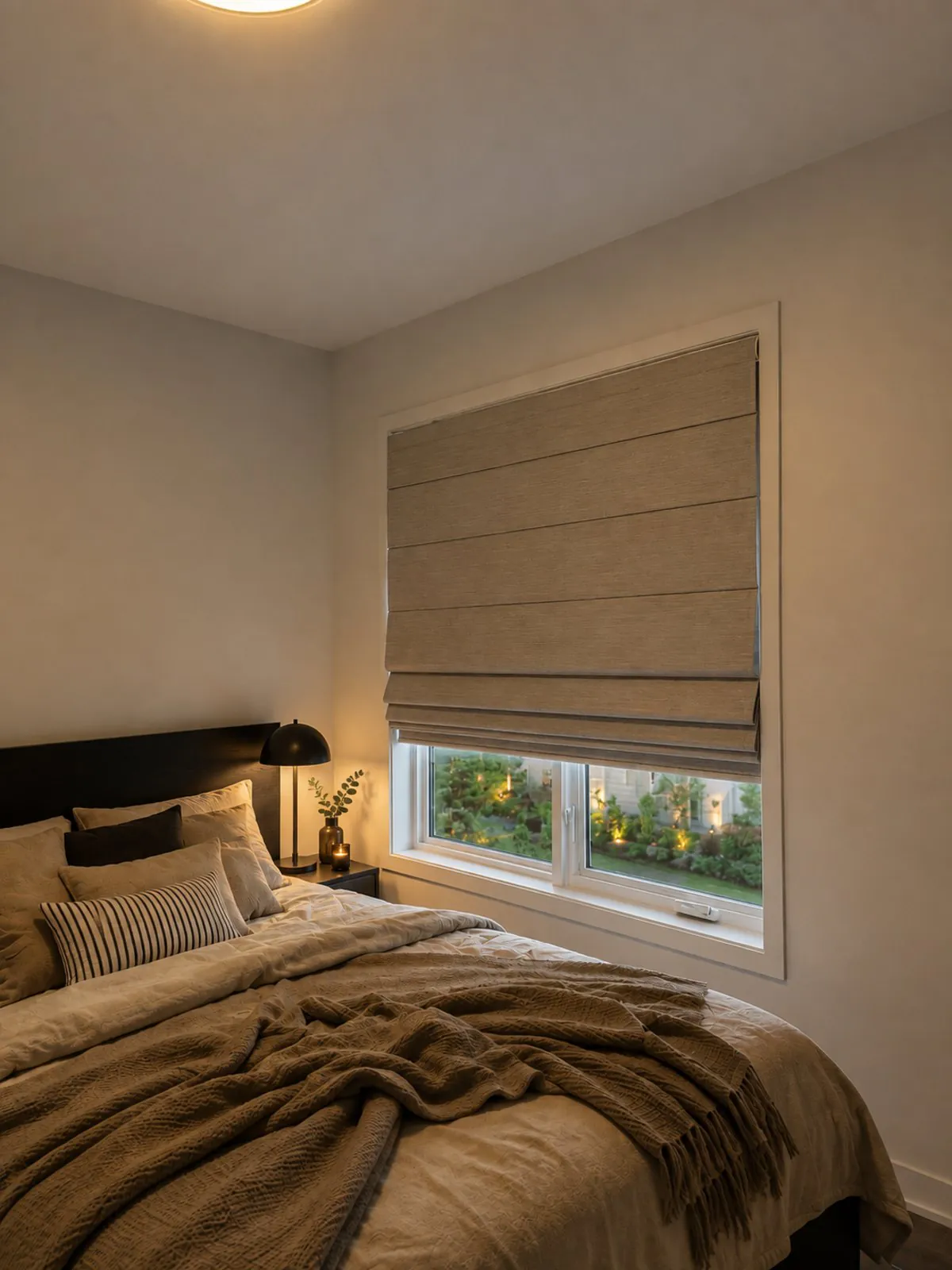
A Roman shade is a flat panel of fabric with horizontal rods or seams stitched across the back. As you raise it, the fabric gathers into a stack of even folds at the top of the window; lower it and it hangs flat and smooth. It’s a blind made of curtain fabric — structured but soft.
How they work
Cords (or a motor) run up the back of the shade through rings on each fold rod. Pull, and the bottom rises fold by fold. Because it’s made from real drapery fabric, a Roman shade can be lined for body, thermally lined for insulation, or blackout-lined for bedrooms.
Styles
- Flat Roman — smooth, clean face when down; crisp folds when raised. The modern favourite; great for patterns.
- Hobbled (looped / teardrop) — soft permanent folds even when fully lowered. Warmer, more traditional.
- Relaxed — a gentle curve at the bottom hem for a casual, softer look (best on windows you rarely raise).
- Reverse fold — the stiffening dowels sit in pockets stitched across the shade, so each fold tucks under itself crisply as it rises and needs almost no dressing, then lies flat when lowered. The trade-off: the pocket seams show as fine lines on the face and break up a large pattern, so it suits plain and textured fabrics best.
Fabric
Linen and linen-look weaves are the classic choice — texture without heaviness. Cotton and cotton blends take pattern well. Heavier weaves feel richer. Almost any drapery fabric works, which is where Roman shades beat every other blind for choice.
Honest pros and cons
Pros
- Softness and elegance of fabric, in a blind’s footprint.
- Huge fabric range — texture, colour, pattern.
- Can be lined — thermal or blackout — for insulation and darkness.
- Great in kitchens and small windows where curtains would be too much.
- Layers beautifully with sheers or curtains.
- Cordless and motorized options.
Cons
- Folds stack at the top and cover part of the window when raised (unless mounted above the frame).
- Cost more than roller blinds — real fabric plus lining and construction.
- Not for very wide spans — over ~2 m they get heavy; consider two shades or curtains.
- Not ideal in steamy bathrooms unless the fabric is chosen carefully.
- Cleaning is dust/vacuum — not a wipe-down.
At a glance
| Insulation | Very good when lined |
|---|---|
| Light control | Filtering to blackout by lining |
| Privacy | Excellent when down |
| Style | Designer favourite |
| Maintenance | Dust / vacuum |
| Best rooms | Living rooms, dining rooms, bedrooms, kitchens (with care), small & feature windows |
| Options | Flat / hobbled / relaxed · lined / thermal / blackout · cordless · motorized |
Who they’re perfect for
If you love the softness of fabric but want it neat, this is your blind. Roman shades are our pick for dining rooms, living rooms and bedrooms where curtains would be too much fabric, for kitchens (a washable-fabric flat Roman over the sink is a classic), and for anyone whose taste runs to “quietly expensive.”
Mount the shade above the window frame (outside mount) so the raised stack sits over the wall, not over the glass. You keep the whole view and the window looks taller. We’ll advise on site.
When to choose something else
- Very wide window or patio door? Curtains or a roller blind.
- Top priority is insulation? A honeycomb blind.
- Want to flick between view and privacy constantly? Zebra blinds.
Frequently asked questions
Are Roman shades good for bedrooms?
Yes — with a blackout lining they’re excellent, and they look softer than a hard blind. Add side channels or an outside mount to reduce light at the edges.
Flat or hobbled Roman shade?
Flat for a clean, modern look (and for patterned fabric). Hobbled for a softer, more traditional feel with permanent folds.
Can Roman shades be motorized?
Yes. Motorized Roman shades are quiet and very convenient on hard-to-reach or multiple windows.
What is a reverse fold Roman shade?
One whose dowels sit in pockets stitched across the face, so each fold tucks under itself as the shade rises and needs almost no dressing by hand. It hangs flat when lowered and suits plain or textured fabrics best, because the pocket seams show as fine lines and interrupt a large pattern.
Are they hard to clean?
Dust or vacuum on low. Some fabrics can be spot-cleaned. They’re not a wipe-clean surface like a roller blind, so we steer kitchens toward washable fabrics.
Do you install them?
Yes — made to measure and installed free across Quebec and Ontario.